Something is wrong with the hand. Third finger bends backward at the second knuckle, holds there for 6 frames, then corrects itself like it forgot the rules. The shadow under the jawline flickers. The hair moves but the wind does not. You notice these things now. In 12 months you will not.
AI generated video sits at the edge of the uncanny valley, one foot still dangling over the drop. Sora made people gasp in February 2024. Kling made people plan in June. Runway Gen-3 made people reconsider entire production pipelines by autumn. Veo 2 from Google landed in December and the conversation shifted from “can it” to “when will it.” Now Seedance from ByteDance renders motion that feels almost biological. Almost.
That almost is doing a lot of work. It is the last wall. And every month it gets thinner.
Chinese director Jia Zhangke released this short. 100% AI generated. If you can find the seams, you are doing better than most.
What Is The Actual End Goal
Nobody seems to agree. Ask a startup founder and the answer is democratisation. Ask a studio executive and it is cost reduction on CG heavy sequences. Ask an indie filmmaker and it is the chance to punch 40 weight classes above their budget. Ask a hobbyist and the answer is something less defined. Something closer to play.
I keep circling back to a selfish thought. Raymond E. Feist wrote The Magician in 1982. Pug, Tomas, the rift war, Kelewan. A world that lived in my head for decades. I have waited for someone in Hollywood to see what Feist built and do for it what Peter Jackson did for Tolkien. Nobody came. Nobody is coming.
What if the end goal is not making movies for audiences but making movies for yourself?
The idea sounds absurd until you sit with it. Directing scenes from a novel nobody will greenlight. Casting faces that match your internal image. Choosing the light, the framing, the pace. Not for distribution. Not for profit. For the private satisfaction of seeing a story you love move on a screen exactly the way you imagined it.
That is a market nobody is modelling. Personal cinema. Films of one.
The Industry Reacts The Way Industries React
Badly and late.
Disney has started folding generative tools into its pipeline. The same company that sued a daycare for painting Mickey on a wall now sees AI generation as a competitive edge. The irony is so thick you could render it in 4K.
Then there was the clip that rattled the whole town. Tom Cruise fighting Brad Pitt. Not a movie. Not a trailer. A deepfake so convincing it triggered emergency meetings across every major studio. That single clip did more to accelerate AI policy in Hollywood than a decade of academic papers.
The response was predictable. Legal filings. Cease and desist letters. Lobbying. The latest target is ByteDance, parent of TikTok and developer of Seedance. American lawyers want injunctions. They want precedent. They want control.
US legal frameworks assume the offending server sits inside a jurisdiction that respects the ruling. Chinese companies have shown repeatedly that they do not. The DMCA is a domestic instrument being aimed at an international target with no extradition mechanism for bits and pixels.
They are filing paperwork against a tide. The models are already distributed. The weights are already copied. Open source variants are already training on hardware outside any single government’s reach. You cannot contain what has already escaped.
The China Cloud Problem
The infrastructure for this future will not live in Virginia or Oregon. It will live in Shenzhen and Shanghai.
Chinese cloud hosting operates under different rules. No DMCA takedown regime. No statutory damages for likeness infringement. No court order that an American judge can enforce against a server rack in Guangdong Province. The content moderation frameworks that American and European companies implement as a matter of survival simply do not apply.
Every dopamine hit clip you render, every scene of Pug walking through the rift, every reimagined fight sequence from a novel you love, will sit on infrastructure that Western lawyers cannot touch. The platforms hosting it know exactly what they are doing.
The real competition is not between AI models. It is between legal systems. And the one with fewer rules wins by default.// The quiet part said loud
The talent dilution is already happening. VFX artists who spent years mastering fluid simulations and cloth dynamics are watching tools replicate 80% of their output in minutes. Not the top 20%. Not the work that requires genuine artistic judgment. But the volume work. The filler shots. The establishing sequences. The connective tissue of modern filmmaking. That work is being targeted first. Human artists still do it better, so they can hold the line for now. For now.
What Gets Lost And What Gets Found
I am not naive about what this displaces. Real artists will lose real work. Real studios will use this as an excuse to slash budgets they should have been spending on craft. The consolidation will be ugly and the people absorbing the damage will not be the executives announcing the strategy.
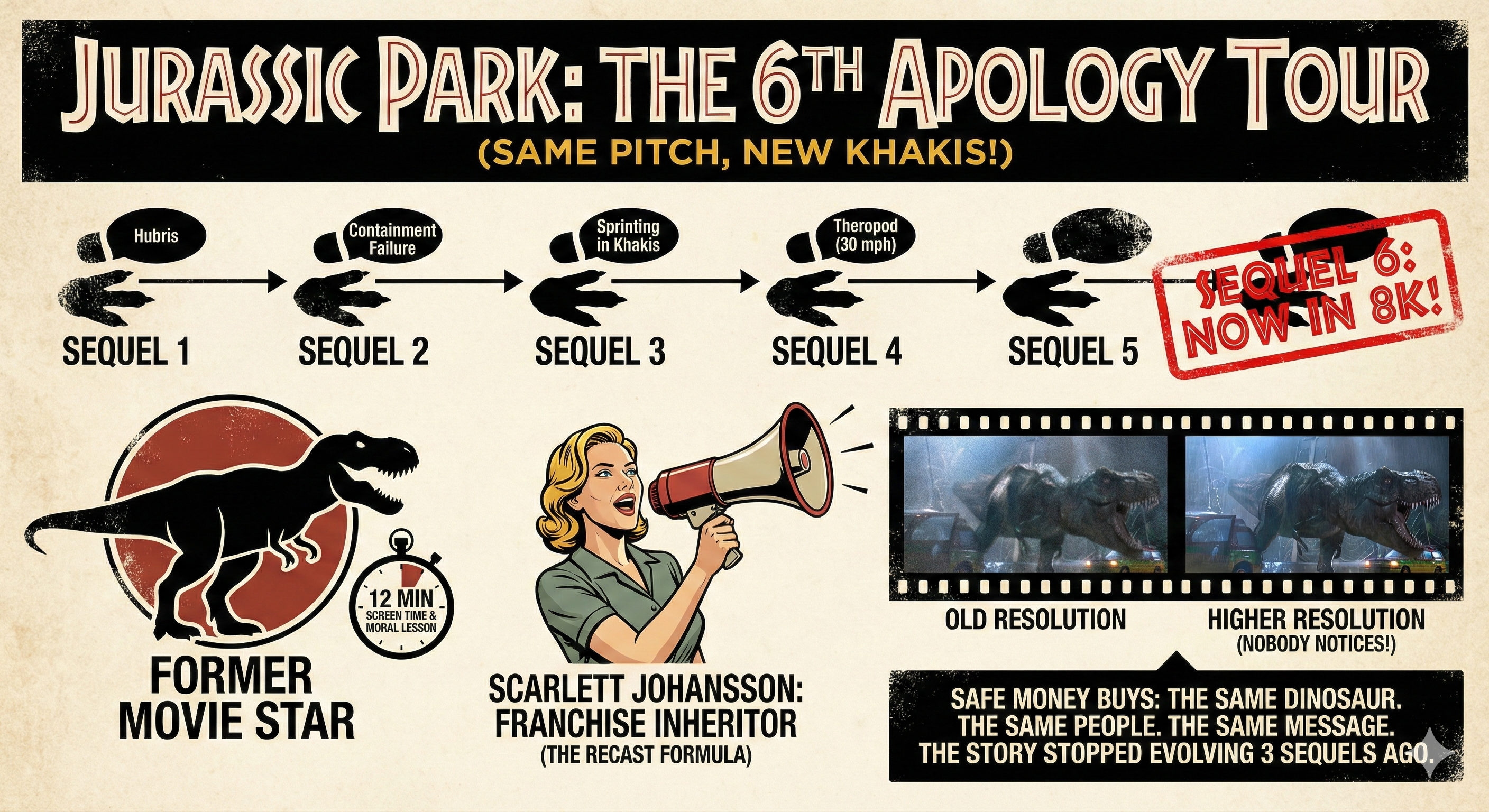
But I also cannot pretend the old system was generous. Hollywood never made The Magician. It never made half the novels readers begged for. It made sequels and reboots and intellectual property extensions because the economics demanded safety. The system that AI threatens was never one that served niche audiences. It served quarterly earnings. Jurassic Park is on its 6th apology tour. Same pitch every time: hubris, containment failure, someone in khaki shorts outsprinting a theropod that clocks 30 miles per hour. The T-rex used to be the movie. Now he gets 12 minutes of screen time and a moral lesson about respecting nature while Scarlett Johansson inherits the franchise and the audience pretends the recast changes the formula. This is what safe money buys you. The same dinosaur chasing the same people past the same message, rendered at higher resolution each time so nobody notices the story stopped evolving 3 sequels ago.
What generative video offers is a crack in that wall. Not a replacement for cinema. Not a shortcut around storytelling. A crack. Enough light to let someone who loves a story make a version of it that lives outside the system that refused to.
The fingers will stop melting. The shadows will land correctly. The hair will obey the wind. And when that day comes, the fight will not be about whether the technology works. It will be about who controls the server it runs on.
That fight is already lost.
// SENSOR_DATA_OVERLAY: FIELD_INTENSITY 0.92Hz
// "The design isn't just a shell; it's a sensory interface for the model's weights."